

With the introduction of the Acceptable Use Policy (AUP) last year, we are already seeing positive results, particularly in faster resolution times for service desk tickets and improved communication with providers. As such, we would like to share some of the internal details with you. While the Network is functioning well at present, with fantastic growth in IIA, LAs, and, recently, nominations, some minor roadblocks can still appear. Any blockages or unresolved tickets, however uncommon, can inhibit the Network and have knock-on effects for all users.
To address this, an Acceptable Use Policy (AUP) was put in place, enforced by the EWP Consortium in coordination with DG EAC of the European Commission. This introduction was discussed and agreed upon with all nodes prior to coming into force. The AUP defines rules, principles, and service-level agreements (SLAs) for providers. Two of its most vital requirements are that:
- All software used for Network nodes accessing EWP must comply with the established mandatory business requirements and technical specifications, ensuring full interoperability between all connected EWP nodes.
- All connected service providers must support the common EWP service desk and respond to open tickets within the timeframe defined in the SLA annexed to the AUP.
For users, the second requirement has likely been the most visible. Any user within the EWP Network can create a ticket within the ESCI Service Desk to report an interoperability issue. For every interoperability ticket, ESCI Service Desk agents reach out to providers involved in the exchange to identify the source of the issue and make sure the responsible party solves the issue at hand. Response time requirements under AUP to such issues depend on the provider’s status:
- 5 working days for commercial third-party mobility software providers
- 7 working days for HEI in-house mobility software providers
You may already have noticed more reliable response time from providers to tickets. Indeed, during the first three months of AUP coming into force, a 72% decrease in AUP breaches by providers was recorded (29 to 8). The AUP has already brought significant benefits for both users and providers. The consistent application of AUP warnings in relation to ticket resolution has improved responsiveness and led to faster resolutions, reinforcing shared responsibility across the Network. For users, this means removing roadblocks to smooth mobility management with partner institutions.
For providers, the AUP sets clear expectations in issue resolution. It also enables the Consortium to identify certain providers causing a disproportionate number of tickets and to initiate constructive dialogue on how to collaboratively prevent further issues. This results in improved cooperation and transparency between providers and the Consortium.
Consequently, as of February 2026, AUP breaches have not required escalation beyond formal reminders.
Looking ahead, continued collaboration within this structured framework will further support a more reliable, transparent, and resilient EWP ecosystem. We would encourage all users to submit interoperability Service Desk tickets whenever they see an issue arise. The benefits of AUP described here can only be realised when it is actively used. If something is not working as expected, please log a ticket with the ESCI Service Desk so that it can be properly investigated and resolved.
Download (pdf): Acceptable Use Policy
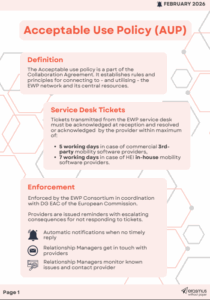
Photo by Constantine Kim on Pexels