
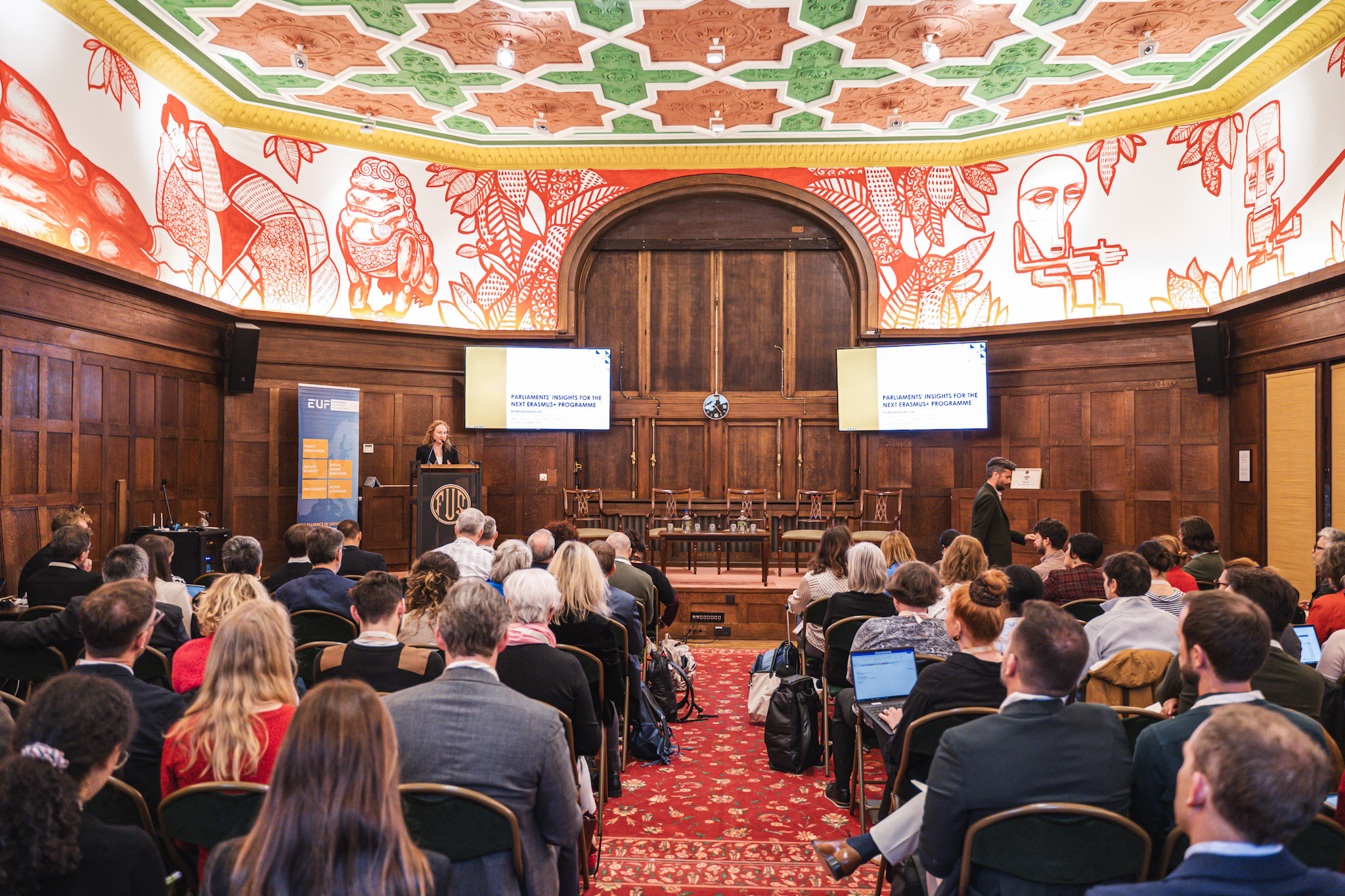
“Erasmus+ is not just a funding line, it is one of the most tangible ways in which young people experience Europe” – Member of the European Parliament, Helder Sousa Silva at the EUF 2026 April event in Brussels.
On the 20th–21st of April, the European University Foundation was a full house at the Fondation Universitaire. At the heart of this historic building in Brussels, close to the European Parliament, over 50 EUF members and 30 stakeholders joined us to discuss the EUF recommendations for the next Erasmus+ programme period. This event is the culmination of one year of discussions and reflections involving all the EUF members and Communities, kick-started in April 2025 with a policy workshop held in Brussels.
Supported by outstanding speakers, the conference dove into the details of how the European Union can enable a smooth transition into the new 2028-2034 programme period whilst also supporting major reforms in the Erasmus+ programme. As part of the first day of the event, EUF members discussed and debated ideas stemming from their nearly 12 years of experience in bottom-up Erasmus+ strategic cooperation projects.
Some of the notable EUF recommendations for the next programme are to:
- Substantially improve the governance of the Erasmus+ programme in particular by structuring the input of practitioners and stakeholders.
- Make the Erasmus truly inclusive for students by revising the grant calculation mechanism that include city-level cost of living adjustments.
- Extend existing Inter-institutional Agreements to save hundreds of thousands of hours of administrative work allowing institutions on their qualitative rather than merely administrative management.
- Ensure stability of the digital ecosystem when digitalising the management of the Erasmus+ programme.
- Support green travel in Erasmus+ by providing students with a European green travel ticket.
On the second day, the EUF hosted debates between stakeholders and welcomed the presence of Katarzyna Biniaszczyk, Accredited Parliamentary Assistant of the Rapporteur of the Erasmus+ file in the CULT Committee of the European Parliament. Participants learned more about the timeline for the Erasmus+ programme negotiation at the EU level between the European Commission, the European Parliament and the Council of the European Union and discussed how the involvement of national authorities can help push for a stronger Erasmus+ budget. Later, the conference welcomed the presence of the culture and education (CULT) Committee and budget Committee (BUDG) Member of the European Parliament, Mr Sousa Silva. During the session, he announced that both CULT and BUDG Committees will call to increase the budget of Erasmus+ to a minimum of 47 billion euros, and urged the EUF network to continue supporting the ongoing policy debate on the design of the Erasmus+ regulation.